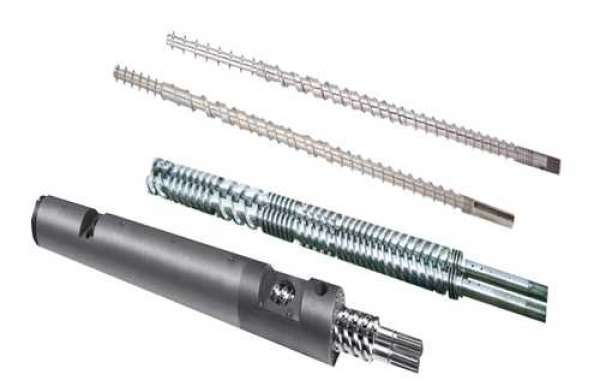

We provide the highest range of Bimetallic Screw Barrel for plastic injection molding machines, plastic extruders, plastic blow molding machines, plastic recycling machines, rubber extruders, and food processing machines.
Combine different products according to your budget:
1. Full bimetal screw and barrel group
2. Bimetal barrel with nitriding screw group
3. Nitriding barrel with bimetal screw group
4. Metal-ceramic coated nitrided screw and barrel group
5. Cermet coated screw with bimetal barrel set
6. Cermet coated screw with nitriding barrel group
7. Cermet coated screw, bimetal bushing barrel
8. Standard Stellite coated screw and barrel set
9. Standard Colmonoy coated screw and barrel group
The following standard size bimetal screw barrels are available:
Screw diameter range: 22 mm to 250 mm
Barrel outer diameter range: 52 to 355 mm
Bimetal screw length: 800 mm to 9000 mm
Standard length-to-diameter ratio of bimetal screw barrel group: 6, 8, 10, 12, 20, 21, 22, 25, 26, 28, 30, 31, 32, 33, 34, 35, 36, 38, 40, 45, 50.
What is a bimetallic screw barrel?
"Bi" means "two".
So simply put it is a product composed of two metals or alloys. (Two is always better than one)
In bimetal products, two metals are fixed together, rather than mixed together. The mixture of two (or more) metals is called an alloy.
Screw barrel with bimetallic characteristics. The bimetallic screw barrel is made of two metals or two metal alloys, most of which are coated with additional carbide layers and other commercial coating materials.
The bimetal screw barrel is not a different type of screw barrel, such as advanced design. Screws of the same design can be manufactured by nitriding and bimetallic methods.
Many customers ask us to give them a bimetal screw when they have questions about their screw design (not made by us) because "someone" told them to use a bimetal screw. Bimetal screw is used to increase the life of screw and barrel, because bimetal has better effect than single metal.
If you are looking for a screw barrel with advanced design, such as super torque, super speed and high output, please contact our RD team or read more pages on this website. We make screw barrels according to your needs. The advanced design screw barrel can be made of nitrided steel (single) or bimetal (Bi) according to the customer's budget.
Figure 1 Thermal spray coating method and difference of bimetal screw barrel
The bimetallic screw barrel is made of two alloys (metals): first as the base material, and second as the coating material, so they have a longer life than single metal steel.
But this is not the case in all cases. For example, D2 grade tool steel (single metal) is used to make screws (up to 1250 mm), so the life of these screws is the same as that of bimetal screws (2 to 5 times that of nitrided steel) ), depending on the compounding and processing technology).
In addition, to improve wear resistance, it is still not a bimetallic screw. Because carbide (WC) is neither a metal nor a metal alloy. For example, tungsten carbide (WC) is a composite material called cermet. Tungsten (W) is a metal (the hardest), and cemented carbide is a ceramic. When the two are mixed in different proportions (4% tungsten and 88% tungsten), the mixture is called tungsten carbide (chemical formula: WC). This composite mixture It is called cermet.
Important learning before we start:
1. Tungsten carbide is represented by WC (✓) instead of TC (✗).
2. The bimetal screw barrel is used to increase the service life of the screw barrel, not to increase the output and quality of the final product.
Let's start with the basics:
The plastic/rubber/food/chemical processing feed screw barrel is basically a circular threaded metal shaft with strict tolerances. Due to the harsh and high-pressure environment, they are always at risk of wear or corrosion. This is why the screw and barrel are made of selected grades of steel and undergo surface hardening and nitriding treatment to solve these problems. But generally this is not suitable for abrasive material processing and high-pressure environments, such as glass fiber fillers, calcium carbonate fillers, harsh additives, fluoropolymers, plastic recycling, elastomer compounds, high-speed and large-sized barrels. Once the screw is worn, it will cause many problems in the processing process, such as the quality of the final product, low output, and high energy consumption. At this time, we replaced the old screw barrel with a new barrel. But this will cause downtime. Now where the downtime is most important, we must arrange some other innovative solutions to stop the frequent replacement of the screw and barrel. Sometimes, cheap nitrided screws (not properly nitrided) will wear out even 6 months ago.
Therefore, single steel (nitriding) is easy to wear. The industry has developed many grades of performance steel alloys for specific functions and requirements, but they are very expensive. Using a specific performance grade or high-temperature alloy to manufacture a complete screw barrel may result in a cost that is 6 to 8 times that of a nitrided screw. Why? Because high-temperature alloys and other performance alloys require special processing, they require more time for milling than 4140 or En41b or 38CrmoAlA nitriding steel.
This is where the bimetallic screw barrel comes into play. The cost of the bimetal screw barrel is only 1.5 to 2 times that of the nitriding screw, but the life is 2 to 5 times that of the nitriding screw.
The base material of all bimetallic feeding screw barrels is nitrided steel.
In the plastic/rubber/petrochemical industry, we use nitrided steel to manufacture the feed screw and barrel. When processing food, we use stainless steel grades. Stainless steel is harder and more costly than nitrided steel, and it does not require any post-milling hardening. Nitriding steel enters the nitriding furnace for further hardening.
In this further hardening, nitrogen atoms are deposited on the outer layer of the steel, where they combine with iron atoms to make the surface harder, which is why it is called the case hardening or surface hardening process. Hardening value measured in Rockwell scale (RC or HRC), as you can see in the quotes and specifications.
Extrusion Screw Barrel is also a kind of screw. It is also used in real production. If you want to know more, you can contact us.